Is there a Mercari API? There's no public one, so here are 3 other ways in
Mercari has no public developer API. Here are three working routes to listing and sold-price data, with the price and catch of each.
 Devansh TiwariAuthor
7 min read
As of 9 November 2026 we found no public, self-serve Mercari API. A directory of APIs lists a partner-only API for approved businesses. For Mercari US data you can use an unofficial Python wrapper, a scraping vendor, or a hosted Actor that returns listings and a sold-price summary. None of them has Mercari's backing, so any of them can break.
On this page
Is there a Mercari API?
Not one you can sign up for. As of 9 November 2026 we found no developer portal, API key page or public API docs from Mercari.
The API directory apis.io says Mercari "does not maintain a public developer API" and that "integration is restricted to approved partners (e.g., shipping carriers, payment partners) under direct agreements."
We tried to confirm that on Mercari's own site and couldn't, either way. The business page apis.io links to (about.mercari.com/en/business/) returned a 404 when we checked. The English corporate pages we read mention no developer program. Our answer is no public API that we could find, and nothing from Mercari saying there is one.
If you resell on Mercari US and want sold prices, or you build tools for people who do, you have three ways in:
- An unofficial Python wrapper: free, and you run it yourself.
- A scraping vendor: someone else runs the scraper and sells you the results.
- A hosted Actor: our Mercari US scraper, called over HTTP or from the Apify console.
Disclosure: GetAScraper (that's us) built the Actor in option 3. Each option below comes with its limits, ours included.
One thing to settle first. Mercari Japan (mercari.jp) and Mercari US (mercari.com) are separate sites with separate listings. A tool built for one usually does nothing on the other, so check which site it targets before you pick it.
Option 1: an unofficial Python wrapper
PyPI has a few. On 9 November 2026 we read three project pages:
- mercarius calls itself a "mercari-us api-like wrapper". Its latest release, 1.0.2, came out on 12 August 2023.
- mercari describes itself as "a simple api wrapper around the Mercari jp site" that "simulates API requests by generating tokens". Version 2.2.1, released 28 March 2025. Japan only.
- mercapi is a "Python API for querying and browsing mercari.jp". Version 0.5.0, released 12 September 2026, MIT licence. Also Japan only.
For Mercari US, then, the one wrapper we found has had no release in over two years. We have not run any of the three, so we can't tell you whether they work today.
The catch: a wrapper copies how Mercari's own website talks to its servers. When Mercari changes that, the wrapper stops working, and the fix waits on a volunteer maintainer. The requests also leave from your own machine, so if Mercari blocks anyone, it blocks you.
Option 2: a scraping vendor
Several companies sell Mercari data as a service. Decodo's Mercari page opens with "Resale prices on Mercari move by the hour, and there's no public Mercari API to follow them." It says its scraper API covers both the US and Japanese sites. On 9 November 2026 its site listed its general Web Data API from $0.15 per 1,000 requests. A request is not a listing, so ask them to price your actual volume.
The Apify Store also has Mercari US Actors from other developers. Two examples, at the Free plan prices the Store listed on 9 November 2026:
- parsebird/mercari-us-scraper: $0.00199 per listing, plus $0.039 per search.
- automation_craft/mercari-us-scraper: $0.00133 per listing and $0.006 per run, plus separate fees for item details, price summaries and seller data.
The catch: you depend on someone else's maintenance, and the pricing models differ enough that only a test run on your own keywords tells you what you'll pay.
Option 3: our Mercari US Actor
Our Mercari US Scraper takes a keyword or a Mercari search URL. It returns one row per listing with the title, USD price, condition, brand, category, status, likes and a link. You can limit it to sold or active listings and filter by price and condition. With computeSoldStats turned on, it also saves a sold-price summary for the search.
Here is a real run from 4 November 2026: the keyword "pokemon card", sold listings only, capped at 12.
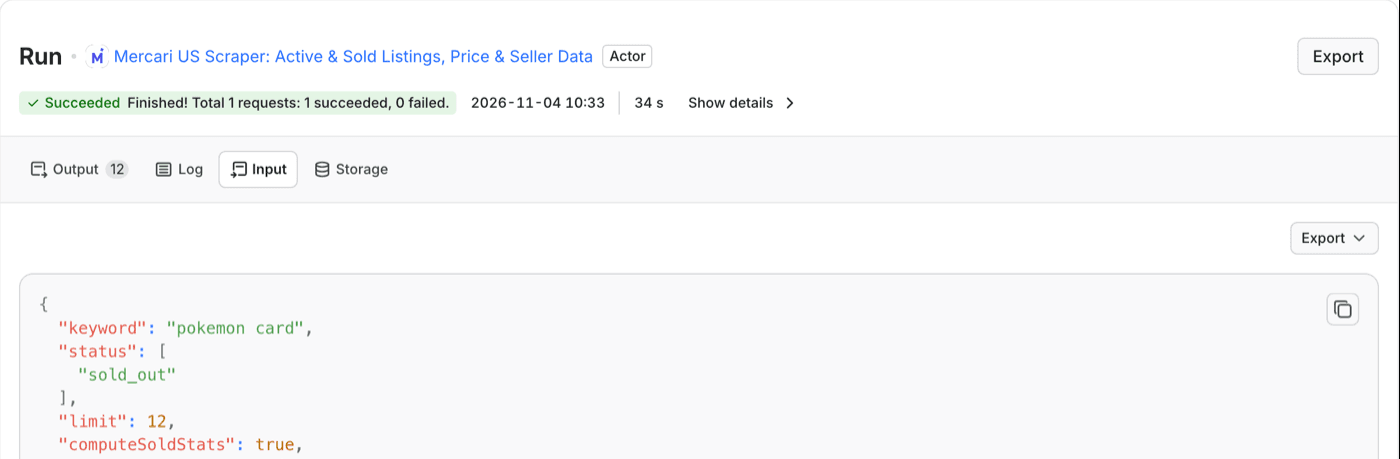
It finished in 34 seconds and returned 12 sold listings priced from $2 to $155.
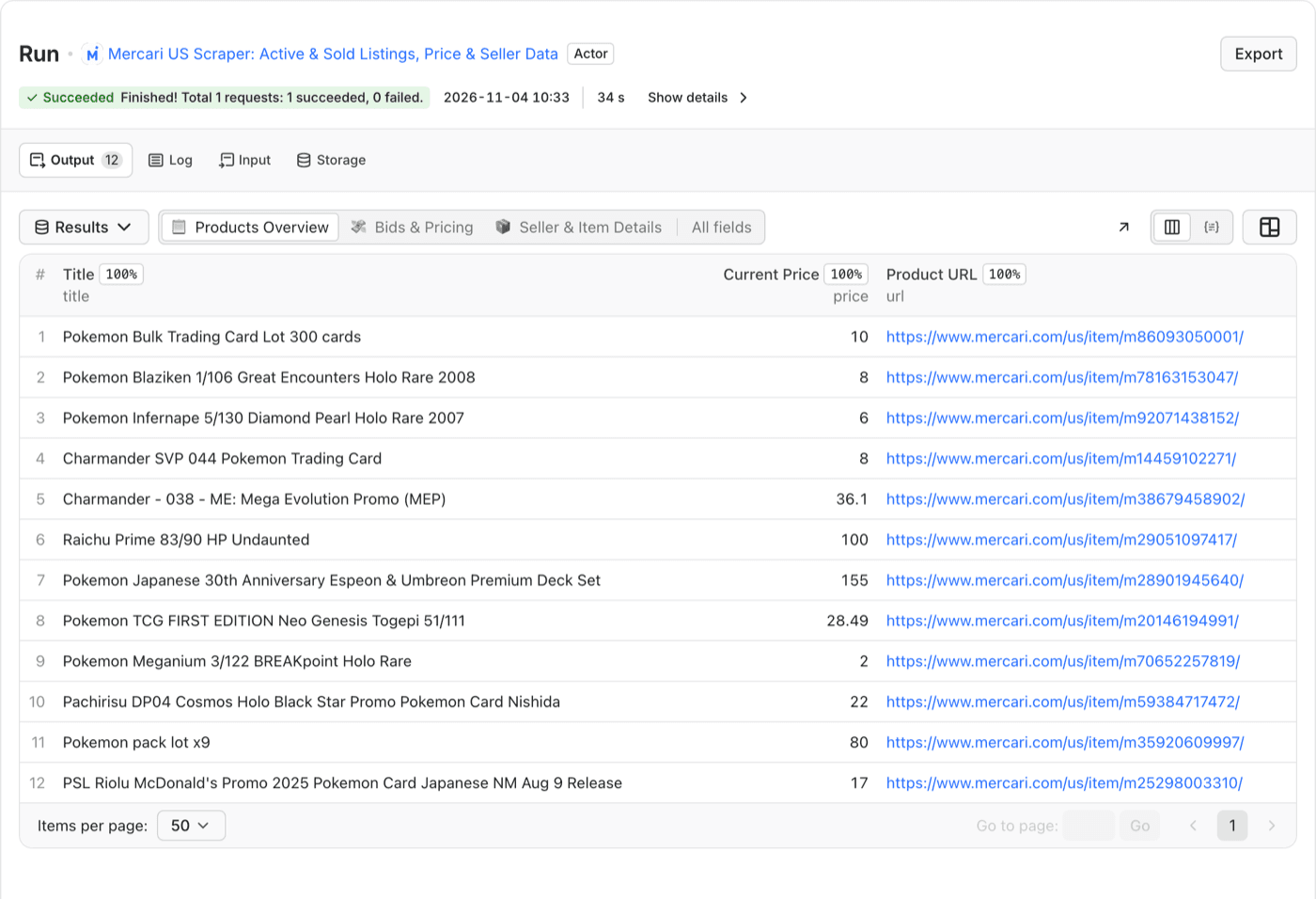
The summary it saved puts the median sold price at $19.50, with the middle half of prices between $8 and $47.08. Twelve listings is a tiny sample. Treat it as a look at the output, not as a price guide for Pokemon cards.
Python example: the Actor
A sold-listings run, called with the Apify Python client:
from apify_client import ApifyClient

client = ApifyClient("YOUR_APIFY_TOKEN")
run = client.actor("getascraper/mercari-us-scraper").call(
    run_input={
        "keyword": "pokemon card",
        "status": ["sold_out"],
        "limit": 50,
        "computeSoldStats": True,
    }
)
for item in client.dataset(run["defaultDatasetId"]).iterate_items():
    print(item["price"], item["condition_id"], item["title"])

summary = client.key_value_store(run["defaultKeyValueStoreId"]).get_record("SUMMARY")
print(summary["value"]["median_sold_price"])
On 9 November 2026 the live Apify API listed the Free plan price at $0.00275 per listing, plus $0.04 per search and $0.00005 per run start. Paid Apify plans pay less per listing, down to $0.00205. At Free plan prices, the 50-listing call in the code comes to about 18 cents. The 12-listing run in the screenshots comes to about 7 cents, and more than half of that is the search fee.
The catch: it costs more per listing than both rival Actors above, and the $0.04 search fee makes very small runs expensive for what they return. It reads Mercari's public pages without Mercari's involvement, so a change on their side stops it until we ship a fix. It covers Mercari US only. For Japan we have a separate Mercari Japan scraper.
Mercari API pricing compared
Mercari sells no public API, so there is no official price to quote. Here is what the alternatives cost, from the pages cited above as read on 9 November 2026.
Prices change, so check each page before you budget.
Which one to pick
- A quick look at a few items: search Mercari by hand and filter to sold items. No tool needed.
- A Python script for Mercari Japan: mercapi, the most recent release of the three wrappers we read.
- Regular Mercari US sold-price pulls, without maintaining code: a hosted Actor. Run ours and a cheaper rival on the same keywords and compare the rows before you commit.
- A product that resells Mercari data: ask Mercari about a partnership before you build on scraping.
What can break
Every route here except the partner API reads Mercari's website without an agreement. Mercari can change its pages or block traffic at any time, and each tool then fails until its maintainer catches up. That includes ours.
The data has limits too. A sold listing's price is the price shown on the listing. We have not checked it against what buyers actually paid, for example after an accepted offer.
Check Mercari's terms of service before you use scraped data in a product. This post is not legal advice.
Questions people ask
Does Mercari have an official API?
Not a public one. As of 9 November 2026 we found no developer portal or public API documentation from Mercari. The directory apis.io describes a partner-only API for approved businesses, such as shipping and payment partners, granted under direct agreements rather than by sign-up.
Can I get Mercari sold prices automatically?
Yes, by reading Mercari's public sold listings with a wrapper, a vendor or a hosted Actor. Our Actor can filter to sold items and save a summary with the median and quartile prices. Pull a few dozen sold listings per item before you trust the median.
Do Mercari Japan tools work on Mercari US?
Usually not. mercari.jp and mercari.com are separate sites, with different listings, currency and pages. Two of the three Python wrappers we found target Japan only. Check the project page or the Actor description for which site it covers before you build on it.
Want Mercari US sold prices in a spreadsheet without keeping a scraper alive?
Open the Mercari US Scraper