How to verify a Chinese company: a real registry record, field by field
Which registry fields to check, read off a real record for Kweichow Moutai, and how to check a whole supplier list at once.
 Devansh TiwariAuthor
9 min read
Get the company's exact Chinese name and its 18-character Unified Social Credit Code, then look it up in China's official registry (gsxt.gov.cn) or a registry copy such as Tianyancha. Check four things first: the status says active, the business scope covers what you are buying, the capital was actually paid in, and the insured staff count fits the size the supplier claims. For a list of suppliers, a hosted Actor returns one record per company for about $0.0145 each on Apify's Free plan.
On this page
- How do you verify a Chinese company?
- What a real record looks like
- The fields that tell you the most
- Option 1: the official registry, by hand
- Option 2: Tianyancha or Qichacha in a browser
- Option 3: check a whole list with a hosted Actor
- What it costs to check 100 suppliers
- What can go wrong
- Questions people ask
How do you verify a Chinese company?
Look it up by its Chinese name and its 18-character Unified Social Credit Code in China's official registry or a registry copy such as Tianyancha. Then check four fields: status, business scope, paid-in capital and the number of insured staff. An English name or a business licence scan proves little on its own.
The official registry is the National Enterprise Credit Information Publicity System, gsxt.gov.cn, run by China's State Administration for Market Regulation (SAMR). FDI China's guide calls it the closest thing China has to a companies house. Tianyancha (天眼查) and Qichacha are commercial sites built on registry data, with court cases and ownership links added.
We read the guides that come up first for this question. Every one we could open tells you to check the registry. None shows what a real record says, field by field, or how to check fifty suppliers without fifty manual searches. This post does both, using one real record from our own run.
Disclosure: GetAScraper (that's us) built the Tianyancha Actor in option 3 below. We are not affiliated with Tianyancha, Qichacha or any Chinese government body.
What a real record looks like
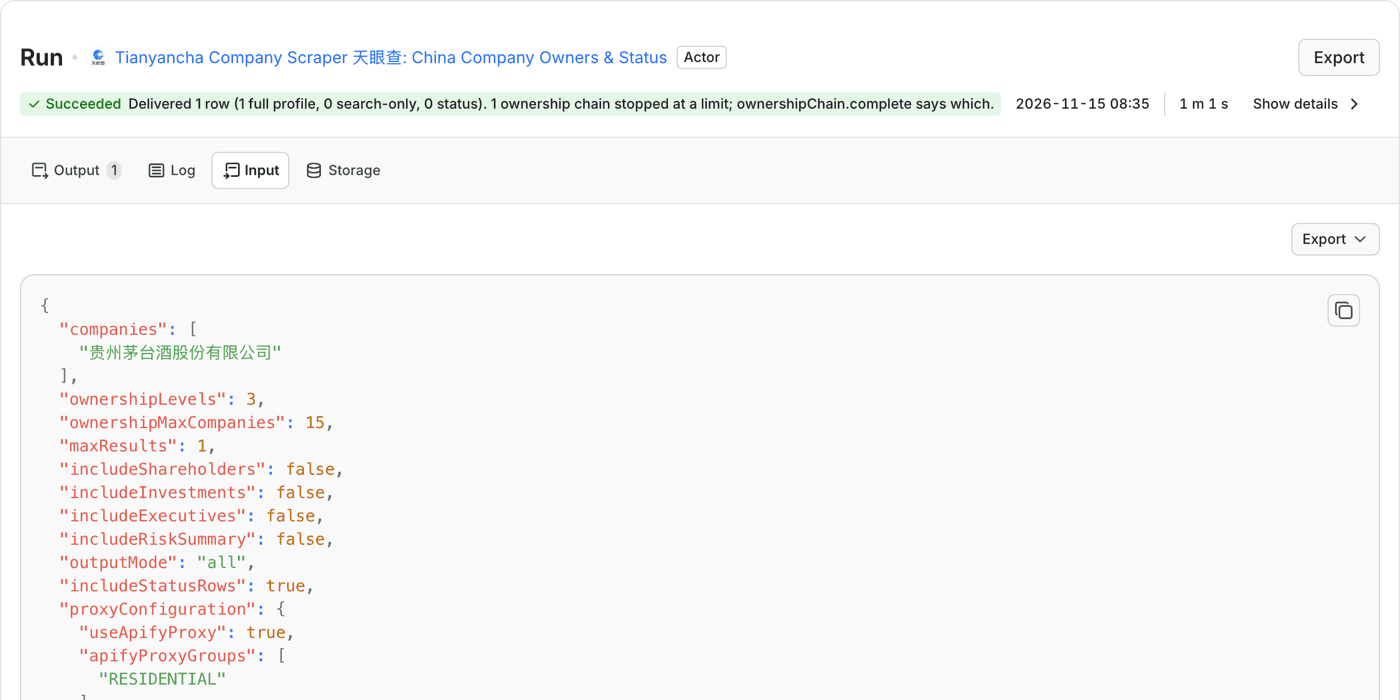
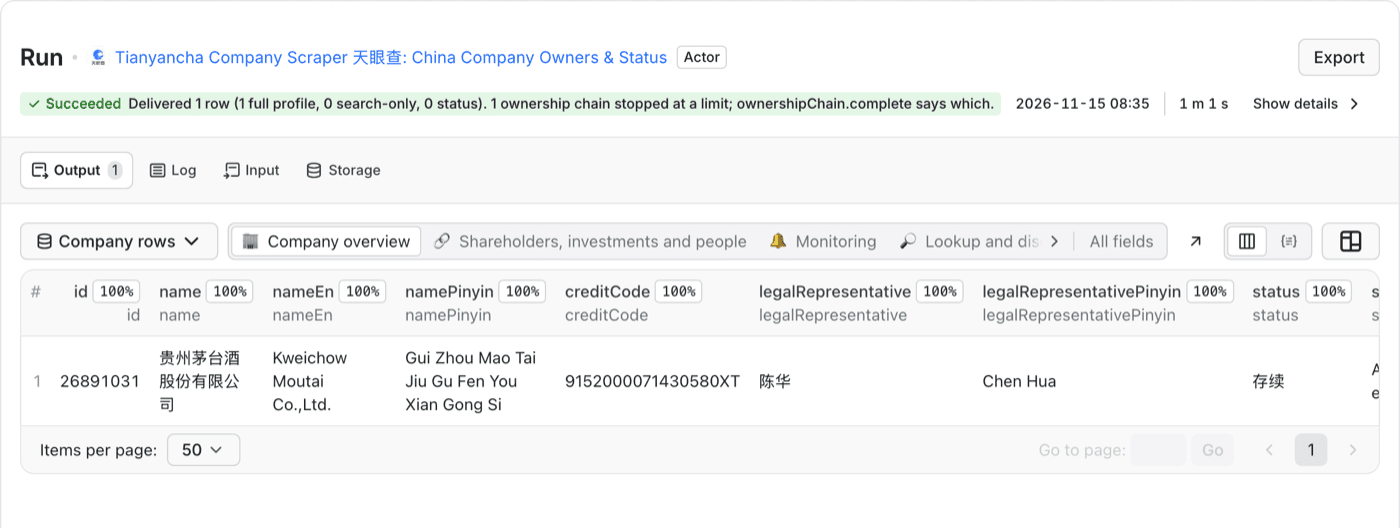
We looked up Kweichow Moutai, the listed maker of Moutai liquor, by its Chinese name, 贵州茅台酒股份有限公司. Our test run asked for the registry profile and a three-level ownership chain. It finished in 1 minute 1 second and returned one row.
The record held more than the table. It counted 42 change records, 89 trademarks, 812 patents, 3 branches and 15 companies Moutai has invested in. Because Moutai is listed, it also carried three years of revenue and profit. Three phone numbers came back masked, and the address, the registration authority and the business scope came back in Chinese only.
The fields that tell you the most
Unified Social Credit Code
Every Chinese company has one 18-character code, and it replaced several older numbers. Moutai's code, 9152000071430580XT, also served as its tax number in the record, and its old 9-character organisation code, 71430580-X, sits inside it. Ask the supplier for the code and search with it. Two companies can have near-identical English names, but they can't share a code.
Status
Moutai's record says 存续, which our run's row gives in English as "Active (in existence)". A company whose licence was revoked (吊销) or that was deregistered (注销) can still have a website and a sales rep. If the status is anything other than active, do not send money until you know why.
Registered capital and paid-in capital
Chinese records count money in 万 (wan, 10,000), so "125227.0215万人民币" means 1,252,270,215 yuan. Registered capital is what the owners pledged. Paid-in capital is what they actually put in. Moutai has paid in all but about 2.2 million yuan of its pledge. A small supplier with a large registered capital and almost nothing paid in is telling you less than the big number suggests.
Insured staff
This is the field we would check first on a factory. The record lists 22,210 insured staff for Moutai for 2025, inside the "10,000 or more" staff range the record also shows. If a supplier says it runs a 300-worker factory and the record shows a handful of insured staff, it may be a trading company that subcontracts the work. That isn't always bad, but you should know before you sign.
Business scope
The scope lists what the company is registered to do. Moutai's covers making and selling Moutai and its other liquors, drinks, food and packaging, plus hotels, vehicle transport and anti-counterfeiting technology. If the product you are buying is outside the scope, ask why.
Owners and the ownership chain
The record listed 10 shareholders. The largest, at 54.5%, is the Moutai group company (中国贵州茅台酒厂(集团)有限责任公司). Our run followed the chain three levels up. It ended at Guizhou's provincial state assets commission with an effective 51.057%, and at Guizhou's provincial finance department with 10.29%. The record marked the chain incomplete because it hit the three-level limit we set. For a private supplier, this is where you find out who you are really dealing with. The record also names the legal representative, in Chinese and in pinyin. If someone else signs your contract, ask what gives them the authority to bind the company.
Tags and court cases
Tianyancha tagged Moutai with labels including 国有企业 (state-owned company), A股(正常上市) (A shares, trading normally) and 司法案件 (court cases). Our run did not ask for the risk summary, so it carried the tag but no case details. A court-case tag on a company Moutai's size means little; on a ten-person supplier, read the cases.
Option 1: the official registry, by hand
Search gsxt.gov.cn with the Chinese name or the credit code and compare the result with the business licence the supplier sent you. It is the source of truth and it costs nothing.
One company at a time gets slow past a handful, and a due diligence column by Dan Harris of the law firm Harris Moure, on Above the Law, says you need someone "fluent in Chinese". When we tried to load gsxt.gov.cn from our own tools, it did not answer, so we can't describe the search page. If you are a Canadian business, the Government of Canada's Trade Commissioner Service says in its guide to due diligence in China that it will do a basic check if you give it the company's Chinese name and local phone number.
Option 2: Tianyancha or Qichacha in a browser
The same Canadian government guide describes Qichacha as a "corporate data aggregator and risk assessment tool" and Tianyancha as a "business registration and legal case tracking platform". Our Tianyancha record put the registry fields next to a court-case tag, trademark and patent counts, and ownership links.
We could not load Tianyancha's own pages with our tools, including its user agreement and membership page. So we can't tell you what a free visitor sees or what a paid plan costs. Our run did show that some contact details come back masked.
Option 3: check a whole list with a hosted Actor
An Actor is a scraper that runs on Apify's servers. Our Tianyancha Company Scraper takes a list of companies and returns one row per company. The list can mix Chinese names, credit codes, 15-digit registration numbers and Tianyancha links. Each row has the registry profile shown above. Shareholders, investments, executives, the ownership chain and a risk summary are optional. It needs no Tianyancha login.
In the last 30 days, 48 people ran it. 2,552 of their 2,561 runs succeeded. None failed, and 9 were stopped before they finished.
Called from Python with the Apify client:
from apify_client import ApifyClient

client = ApifyClient("YOUR_APIFY_TOKEN")
run = client.actor("getascraper/tianyancha-company-scraper").call(
    run_input={"companies": ["贵州茅台酒股份有限公司", "YOUR_SUPPLIER_CREDIT_CODE"]}
)
for item in client.dataset(run["defaultDatasetId"]).iterate_items():
    print(item["nameEn"], item["creditCode"], item["statusEn"], item.get("insuredStaffCount"))
Set "ownershipLevels": 3 to trace owners, as our run did, or "includeShareholders": True for the shareholder list. Rows download as CSV, JSON or Excel. If your suppliers came from a fair, our guide to getting a trade show exhibitor list into Excel gets you the starting list. In our snapshot of one textile fair, 853 Heimtextil 2027 exhibitors came from China.
What it costs to check 100 suppliers
Prices are the Actor's price list for Apify's Free plan. Paid Apify plans pay less.
Our Moutai lookup, with four companies traced in the ownership chain, comes to about 4.5 cents on the Free plan.
What can go wrong
- Tianyancha copies the registry. For a contract or a large payment, check gsxt.gov.cn itself, or ask the supplier for its licence and match the credit code.
- We ran one company, and a big listed one. We have not run a small private supplier, so we can't show you how thin its record is.
- Some fields stay in Chinese: the address, the registration authority, the business scope and most shareholder names.
- Our run's ownership chain stopped at the three levels we asked for. Ask for more levels if the owners are holding companies.
- We could not read Tianyancha's user agreement, so we can't tell you what it says about automated collection. Read it before you collect records at scale. This post is not legal advice.
- Records name people: the legal representative, executives and individual shareholders. That is personal data under China's Personal Information Protection Law and your own country's rules, so keep only what you need.
Questions people ask
How do I check if a Chinese company is real?
Ask for its Chinese name and its Unified Social Credit Code. Look both up in the national registry, gsxt.gov.cn, or a registry copy such as Tianyancha. The record should say active, list a business scope that covers your order and show insured staff that fit the size the company claims.
What is a Unified Social Credit Code?
It is the 18-character ID every Chinese company has. It appears on the business licence and in the registry, and it replaced several older numbers. Kweichow Moutai's is 9152000071430580XT, and its old organisation code sits inside it.
What is the difference between registered and paid-in capital?
Registered capital is what the owners pledged to put into the company. Paid-in capital is what they actually paid. Kweichow Moutai's record shows 1,252,270,215 yuan registered and 1,250,081,601 yuan paid in.
Can I search Chinese company records in English?
Partly. Our Tianyancha record had an English company name, an English status and English labels for the company type and top-level industry, plus the name in pinyin. The address, the business scope and most shareholder names stayed in Chinese. Searching works best with the Chinese name or the credit code.
How much does it cost to check 100 Chinese companies?
With our Tianyancha Actor, a registry profile costs $0.0145 per company on Apify's Free plan, so 100 companies cost about $1.45. Shareholders, investments or executives add $0.01 per company. The official registry is free if you search it by hand.
Checking a list of Chinese suppliers? Paste their Chinese names or credit codes and get one registry record per company.
Open the Tianyancha Company Scraper