Hiring-signal prospecting outside LinkedIn: India, Canada, Israel, Ireland
A job post can tell you a company is growing. Here is how to read them on local boards in India, Israel, Canada and Ireland.
 Devansh TiwariAuthor
7 min read
Job postings on local boards can show you which companies are growing. In the October 2026 runs we checked, a posting named its employer on every row for Instahyre and Job Bank, but on only 46 of 100 rows for AllJobs. Plan to clean the list before you use it.
On this page
Why hiring signals work for outbound
A hiring signal is a public job posting read as a sign that a company is growing and may soon buy related products. Sales teams use it to decide whom to contact first.
A company that opens five engineering roles is spending money on growth. One that hires its first compliance lead may soon need compliance tools. Sales teams read postings like these as timing signals, and Databar's guide to hiring signals, published on 31 March 2026, lays the idea out for outbound sales.
Treat it as a rule of thumb. We have no conversion data showing that hiring predicts buying, and this post does not claim it. It is a cheap way to decide who to contact first.
Disclosure: GetAScraper (that's us) built the Actors named below. Each one gets a real limitation.
Why look beyond LinkedIn and Indeed
Most hiring-signal tools start with LinkedIn or Indeed. On 31 October 2026 we read the two Apify listings with "hiring intent signals" in their titles. One covers LinkedIn and the other covers Indeed. Neither README names another job board.
The LinkedIn listing says it returns sample data by default. Real data needs your own Firecrawl key and LinkedIn session cookies. None of the Actors below asks for a login, cookie or key of yours.
A local employer may list a role on its country's board and nowhere else. We have not measured how often, so treat it as a reason to check.
Which board covers which country
- India: Instahyre and CutShort. Both focus on tech hiring, so they will not help you reach other sectors. Limit: CutShort sometimes hides the employer behind a label such as "MNC".
- Israel: AllJobs, or the combined [Israel Jobs Feed](https://apify.com/getascraper/israel-jobs-feed). The feed adds Drushim, JobMaster, Ethosia, GotFriends and JobKarov. Limit: the boards are Hebrew-first, and many postings come from recruiters or hide the employer.
- Canada: Job Bank. It is the Government of Canada's board. In our 40-row sample, many employers were small local businesses such as restaurants and painting contractors. Limit: the employer website was missing on most rows.
- Ireland: jobs.ie and IrishJobs.ie in one feed. Limit: in the run we checked, IrishJobs.ie returned no rows.
What a real run gives you
Each run below is a real one from our own account. We kept the sizes small, so read the numbers as examples.
How many rows named the employer, run by run:
- Instahyre (India): 50 of 50, on 29 October 2026
- Job Bank (Canada): 40 of 40, from 36 employers, on 29 October
- jobs.ie (Ireland): 12 of 12, from 11 employers, on 18 October
- Israel Jobs Feed: 157 of 304, on 25 October
- AllJobs (Israel): 46 of 100, on 29 October
- CutShort (India): 19 of 100 rows named only "MNC" or a close variant, on 29 October
India: Instahyre
On 29 October 2026 we ran the Instahyre Jobs Scraper with one filter, backend development, capped at 50 postings. It finished in 15 seconds. It returned 50 postings from 39 companies, each with a company name, a size figure and a founding year.
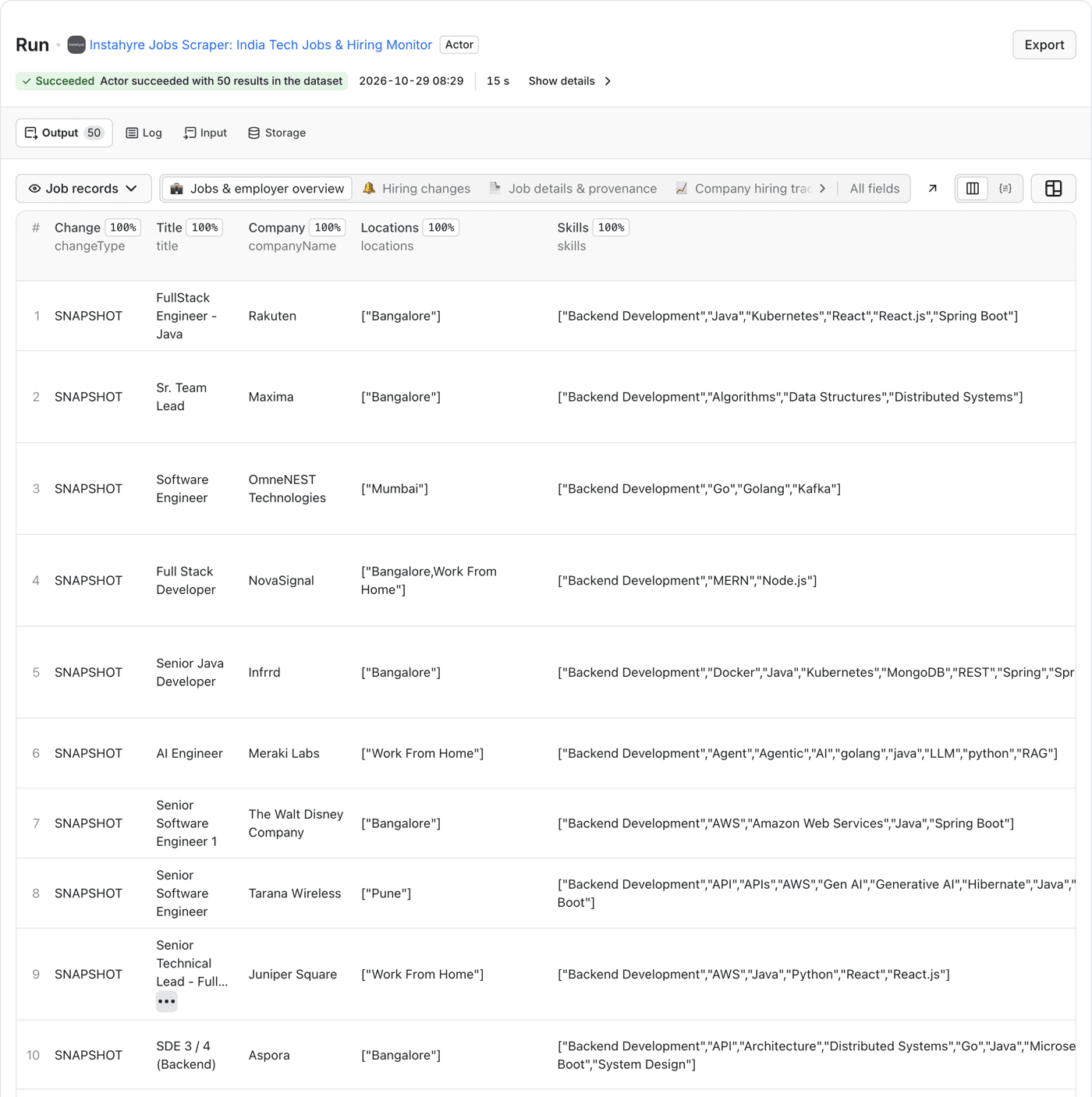
Three companies had three or four open roles in that sample. That is a stronger signal than a single posting.
CutShort works the same way. A 25-row run on 15 October 2026, with company details switched on, gave a company stage on 18 rows and a size on 17. A separate 100-row run on 29 October had 19 rows where the employer was only "MNC" or a close variant. What looks like one firm, under two spellings, filled 20 rows. Counting rows alone would have misled us.
Israel: AllJobs
On 29 October 2026 we ran the AllJobs.co.il Scraper for 100 postings. It took 2 minutes 33 seconds. Only 46 of the 100 rows named an employer, and those 46 rows covered 15 distinct names.
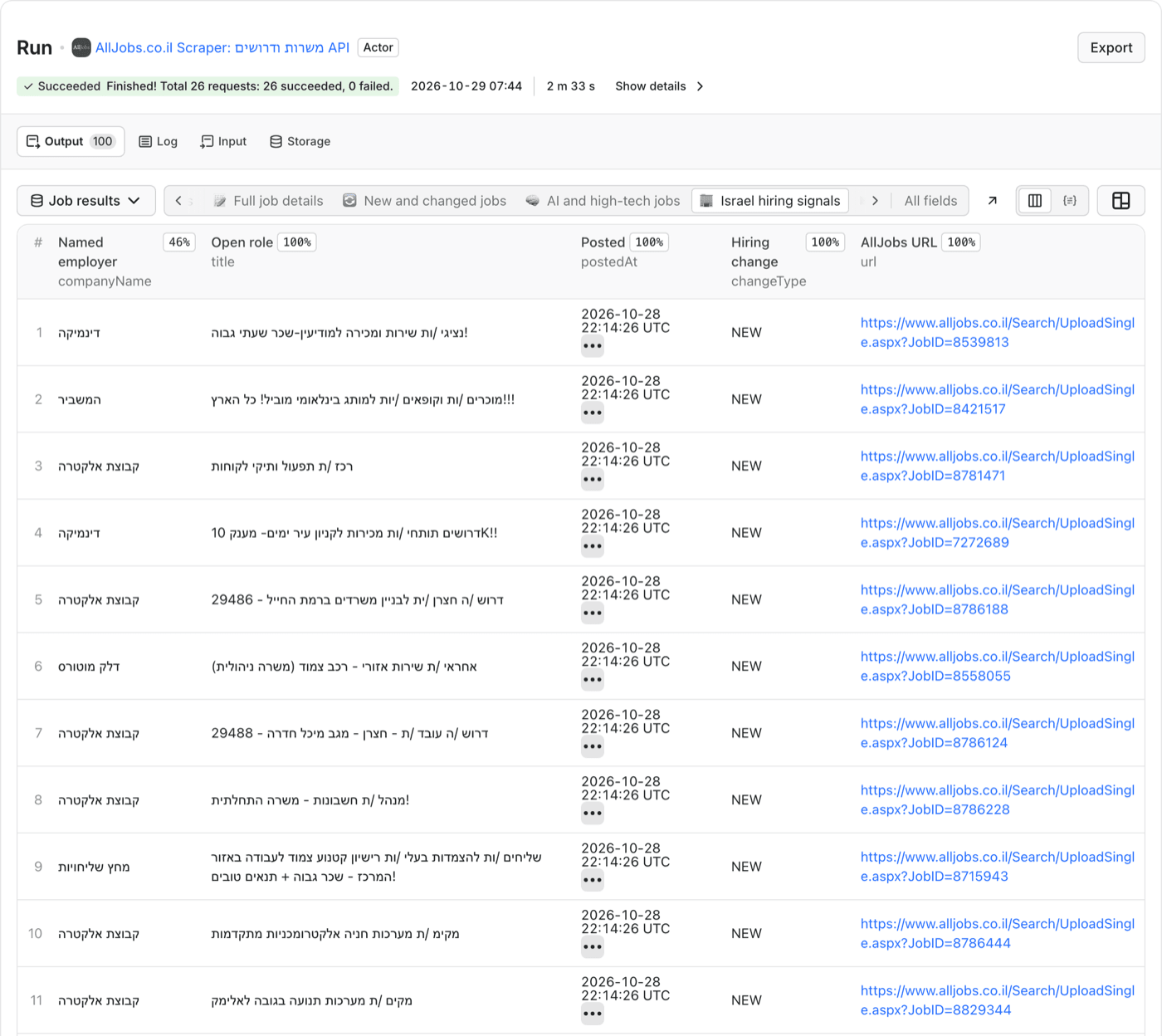
The combined Israel Jobs Feed shows the same gap. A run on 25 October 2026 returned 304 rows across six boards. A company name appeared on 157 of them, and 144 were flagged as posted by recruitment agencies.
Ireland: jobs.ie
On 18 October 2026 we ran the Ireland Jobs Scraper for IT roles, capped at 12 per source. It returned 12 postings from 11 employers, with a salary on 5. All 12 came from jobs.ie. IrishJobs.ie returned no rows in that run.
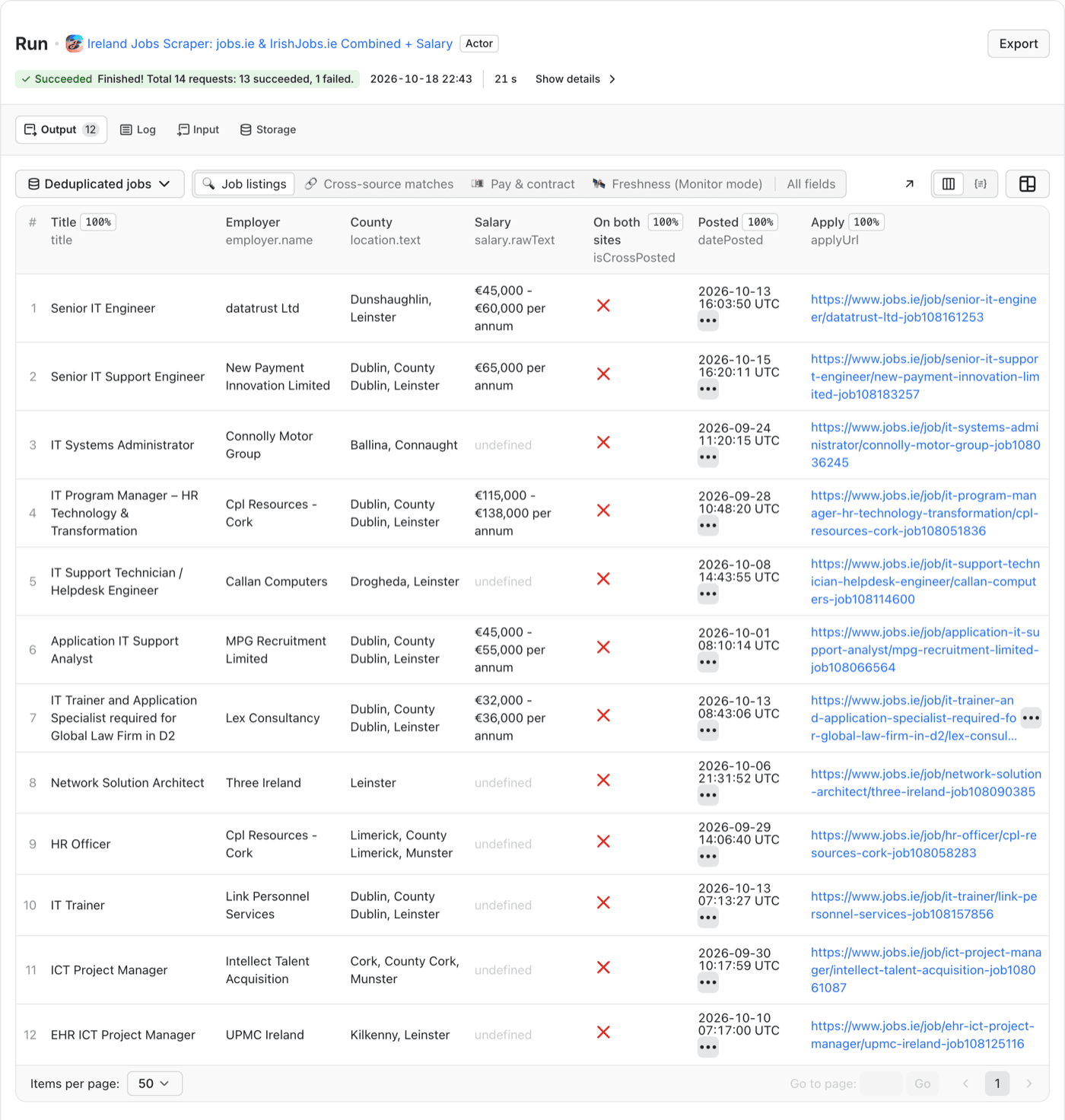
Five of the 12 rows came from four employer names that read as recruitment agencies. The Actor also writes a second dataset with one row per employer and a count of its open roles. That run had 11 such rows.
Canada: Job Bank
On 29 October 2026 we ran the Canada Job Bank Scraper for 40 postings. It took 1 minute 4 seconds. It returned 36 distinct employers, a salary on all 40 rows and an employer website on 13.
Twenty-four of the 40 postings were in British Columbia, so a default run is not a national sample. Filter by province or occupation code. The LMIA field was empty on all 40 rows in this run, so we would not build a list on it. One row was an individual hiring a home childcare provider, so filter out the obvious non-businesses.
Turn postings into a prospect list
- Pick one board and one filter, such as a role family, a province or a city. A narrow list means more than a broad one.
- Run it and export the dataset to a sheet.
- Count open roles per employer. Employers with several roles go first.
- Drop rows with no employer name, and rows from recruiters.
- Add what the board gives you, such as company size, founding year, stage or website, when it is there.
- Check each company's own site before you reach out.
What it costs
At the time of writing, a posting costs this much on the Free Apify plan: $0.00105 on Instahyre, $0.0013 on CutShort, $0.00179 on AllJobs, $0.00089 on Job Bank and $0.0035 on the Ireland feed. The first four also charge a $0.00005 start fee per run.
That is roughly 9 to 18 cents per 100 postings on those four, and 35 cents on the Ireland feed. Some of these Actors also offer an optional paid contact lookup. We did not use it here. Check each Actor page for current rates and any free-plan limits, since both can change.
What this will not do
- It does not tell you who will buy. A posting shows hiring, not budget or intent.
- It finds employers, not decision makers. You still need to find the right person at each company.
- Postings go stale. A role can stay online after it is filled.
- Quality differs by board. The sample runs above went from every row named to fewer than half.
- Rules differ. Check each board's terms and your local rules on outreach. This is not legal advice.
Questions people ask
Does a job posting really mean a company will buy?
Not by itself. A posting shows a company is spending on growth, which can mean budget for related tools, but we have no data on how often it converts. Use it to order your list, then check the company's own site and news before you reach out.
Do I need LinkedIn for hiring signals?
No. Local boards publish many of the same facts: the employer, the role, the place and the date. You lose LinkedIn's profile data. You gain employers that list only on their national board, though we have not measured how many.
Which board should I start with?
Start where your buyers already hire. If you sell to tech companies in India, try Instahyre. For Israel, try AllJobs. Run 50 to 100 postings first and check how many name an employer before you scale up.
Want to see what these boards return for your market?
Browse the job board Actors